The Novel Coronavirus (COVID-19) has been creating global havoc over the past few months. It has forced millions of people across the world into lockdown in their homes, forced many businesses to close and has tragically killed over 2,50,000 people globally at the time of writing. Although the Pharma industry has been invigorated to fight against COVID-19 with drugs and with no vaccines, the industry’s work has also been damaged by the pandemic, primarily through the shatter of supply chains.
McGuire Woods Consulting federal public affairs senior vice-president Stephanie Kennan explains: “The COVID-19 outbreak and measures to prevent its spread disrupted some supply lines because China is a significant source for many active pharmaceutical ingredients.” China was the epicentre of the outbreak, meaning early into the COVID-19 outbreak manufacturing and export declined as factories were closed to curb the spread of the virus.
Although China has now relaxed some of these restrictions, as the viral outbreak spread and became a pandemic, other countries implemented export controls impacting Pharma supply chains. Most notably, India restricted the exports of active pharmaceutical ingredients (APIs) outside of the country because of the COVID-19 pandemic, which “could impact over-the-counter drug, as well as generic pharmaceuticals”; this restriction was only lifted on 7 April. The Pharmaceutical Export Promotion Council reported that India exported $19 billion worth of Pharma products in 2018-2019.
Analysis by Global Data surrounding the COVID-19 pandemic found that the manufacture of 57 drugs is at risk of being affected because of “general manufacturing and export restrictions across China”. These drugs range from calcium supplements to cancer and HIV drugs. It affects some of the world’s largest Pharma companies, such as Pfizer, Johnson and Johnson and Novartis, as well as smaller, more specialist developers, such as Vertex and Jazz. Importantly, in a report, Global Data emphasised not all of these drugs are necessarily in shortage, as most companies have two sources for manufacturing. So far the FDA has only identified two drugs that are in short supply due to Covid-19; the first was not named, Kennan notes, but the second is sedation drug midazolam,, used to put patients on ventilation. However, the regulator has “identified 20 drugs that might be vulnerable”, Kennan notes. These drugs have also not been named, presumably to prevent unnecessary panic from consumers worried about accessing drugs critical to their health and wellbeing.
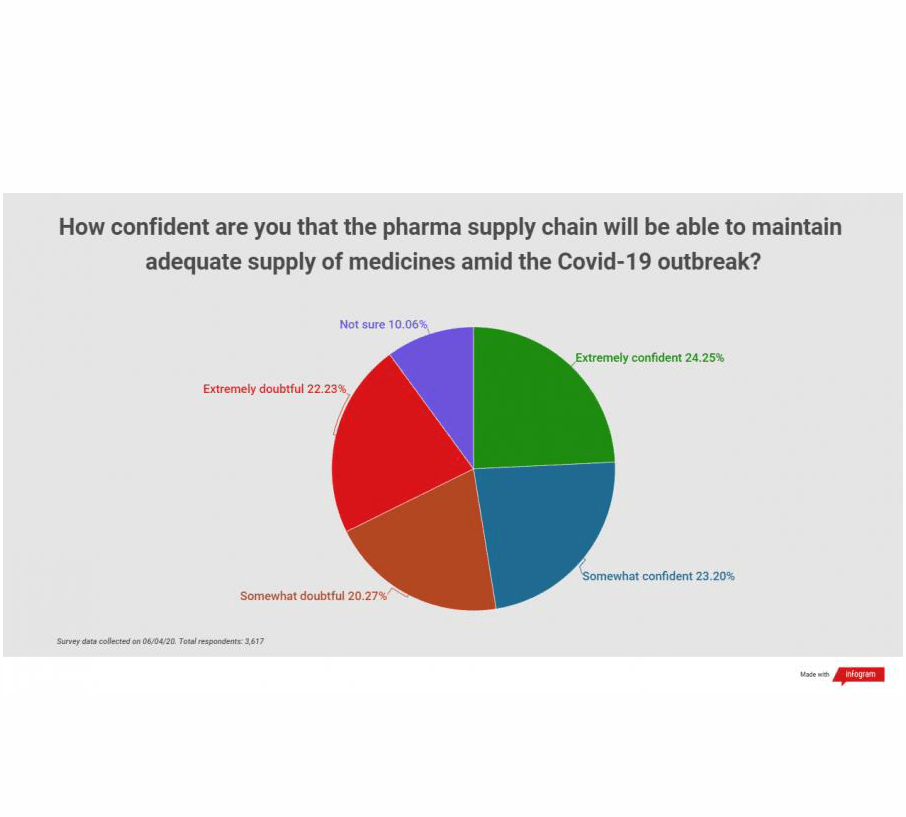
All in all we can say that that COVID-19 exposed the indian industries supply chain vulnerabilities. Readers of Pharmaceutical Technology have been voting on how confident they are that the pharma supply chain will be able to maintain adequate supplies of medicines amid the COVID-19 pandemic.
These results suggest confusion about the extent to which pharma companies are struggling to manufacture and distribute medicines because of the pandemic, and its truly global scale.

 madhavsharmark.blog